







How to Use TikTok in 2026: The Complete Beginner’s Guide

Here's the short version of how to use TikTok in 2026: download the app, sign up, follow a few creators to shape your For You feed, hit the plus (+) button to record a video, add a sound and effects, then post. That's it. The rest of this guide walks you through everything else, including setting up a business account, filming and editing better videos, growing an audience, going live, scheduling posts, and turning TikTok into a real channel for your business.
Whether you're brand new to the app or you already scroll it every day and want to actually use it (not just watch it), this is the complete beginner's guide. Every screenshot, step, and stat has been refreshed for 2026.
What is TikTok and how does it work?
TikTok is a short-form video app. You open it, and instead of choosing what to watch, an algorithm shows you a personalized stream of vertical videos called the For You Page (FYP). You swipe up for the next one. You can like, comment, follow, and reshare, but the main mechanic is watch, swipe, repeat.
Videos on TikTok range from about 15 seconds to 60 minutes, though the shorter formats (under 60 seconds) still dominate. Anyone can record with the in-app camera, layer on a trending sound, add captions and effects, and post. The magic is that the algorithm doesn't need you to have followers to push a video to millions of people, which is why creators and small brands get real reach here that's much harder to earn on Instagram or YouTube.
Under the hood, TikTok is owned by Chinese tech company ByteDance and today has more than 1.5 billion monthly active users worldwide, making it one of the four biggest social platforms on the planet. For a small business or creator, the practical question isn't whether TikTok matters. It's how quickly you can learn to use it well.
How to set up a TikTok account
You can set up a TikTok account in about two minutes. Here's exactly how:
- Download the TikTok app from the App Store or Google Play.
- Open the app and tap Profile in the bottom right.
- Choose how you want to sign up: phone number, email, Apple, Google, or Facebook.
- Enter your date of birth (TikTok requires you to be 13 or older).
- Verify your account with the code sent to your phone or email.
- Pick a username. Keep it short, memorable, and consistent with your other social handles.
- Add a profile picture, a one-line bio that explains what you post, and a link to your website if you have one.
If you're using TikTok for a business, brand, or creator project, switch to a Business or Creator account straight away. Tap the three-line menu on your profile, then Settings and privacy > Account > Switch to Business Account. You'll unlock analytics, the commercial music library, and the ability to run TikTok Ads. Both business and creator accounts are free.
How to use the TikTok app (a quick tour)
The TikTok interface is intentionally simple. Once you know what each part does, everything else is muscle memory.
The five main tabs
- Home: your For You Page (algorithmic feed) and Following feed. Swipe up for the next video.
- Discover / Friends: trending hashtags, sounds, and creators, plus friend content depending on your app version.
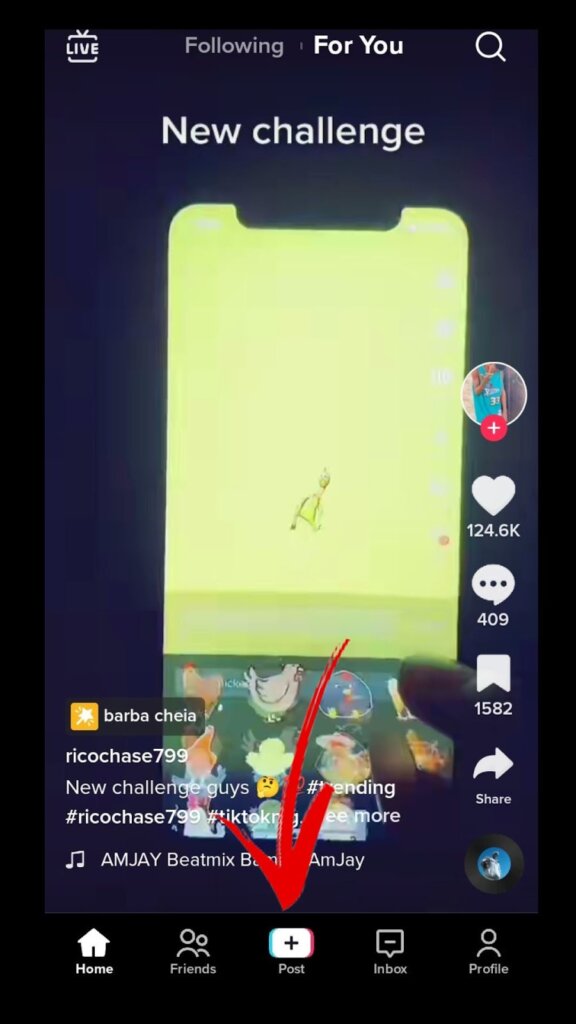
- Plus (+): the big button in the middle. This is where you record or upload a video.
- Inbox: likes, comments, follows, mentions, and messages.
- Profile: your videos, likes, drafts, private videos, and settings.
How to interact with a video
Every video has an action stack on the right side of the screen. Top to bottom: creator's profile, like, comment, save, share. Tap the creator's photo to follow them, tap and hold the screen to open reactions and speed settings, and tap the spinning record at the bottom right to open the sound and use it in your own video.
How to make your first TikTok video
You've got the app, an account, and a rough idea of what to post. Here's how to record and publish your first video.
1. Tap the plus (+) icon at the bottom of the screen
This opens the camera. TikTok has to be given permission to use your camera and microphone the first time you record.
2. Choose your video length
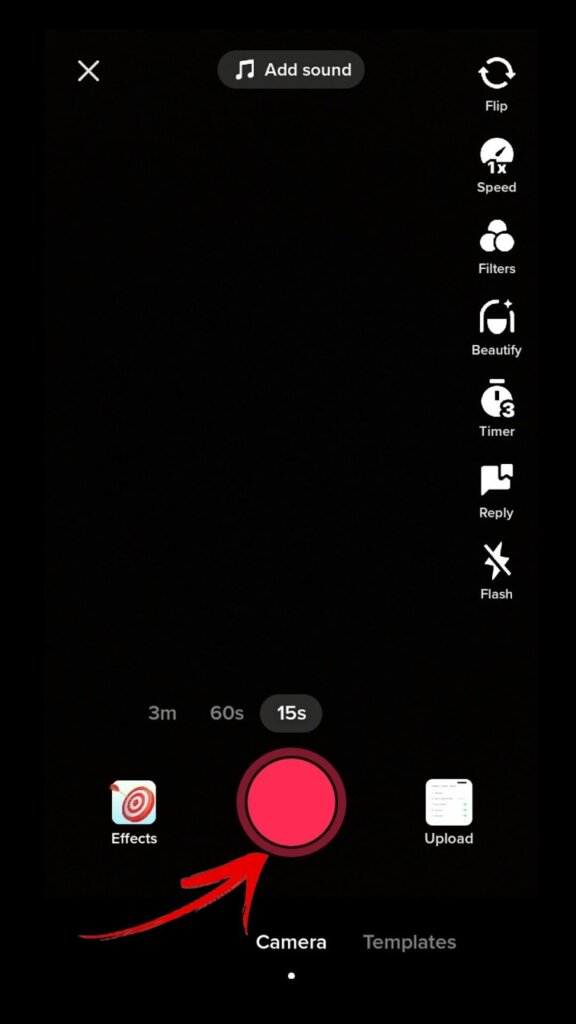
Above the red record button you'll see options for 15 seconds, 60 seconds, 3 minutes, and 10 minutes. Shorter videos generally get better watch-through rates, and watch time is one of the strongest signals TikTok's algorithm uses. If you're not sure, start with 15 to 30 seconds.
3. Add a sound before you record
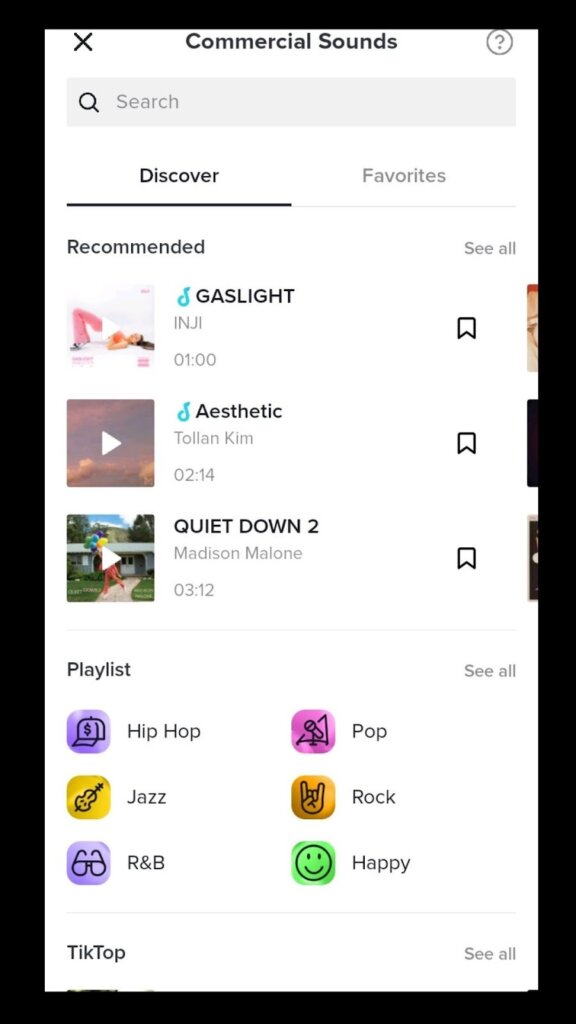
Tap Add sound at the top of the screen and pick a track from the sound library. Trending sounds are marked with an upward arrow. Using one gives your video a small algorithmic tailwind, because TikTok clusters videos with the same sound together. Save sounds you like to your Favorites so you can grab them fast.
4. Record or upload
Hit the red button to record, or tap Upload to bring in an existing clip from your camera roll. You can record multiple clips in one session. The video only submits when you tap the checkmark.
5. Edit your video
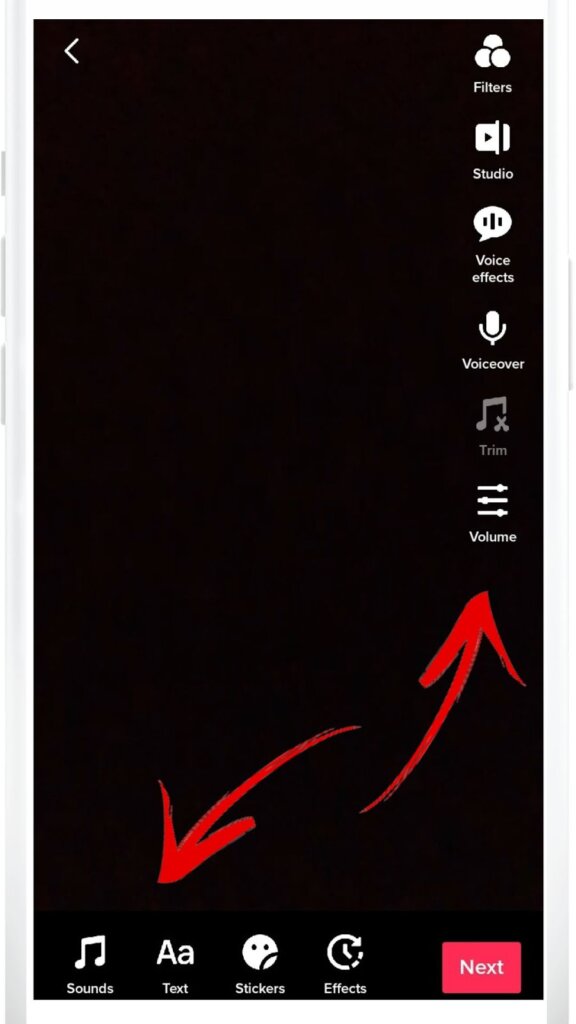
After you record, the editor opens. Add text overlays, stickers, voice effects, voiceovers, captions, transitions, and trim your clips. Captions are worth the extra 30 seconds. They help the roughly 40% of people who watch with the sound off, and they give TikTok more text to categorize the video with.
6. Write your caption and hashtags
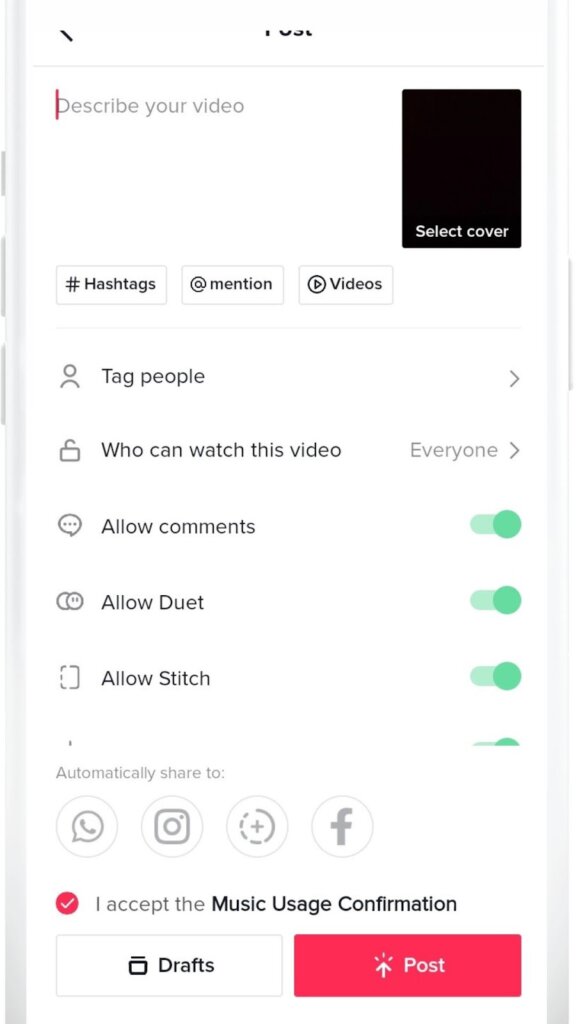
Tap Next to open the post screen. You can:
- Write a description (up to 4,000 characters, though the first 150 are what most people see).
- Add hashtags relevant to your niche.
- Tag friends and other creators.
- Set the audience: everyone, followers, or only me.
- Toggle comments, duets, and stitches on or off.
7. Hit Post
Tap the red Post button. If you're not ready to publish, tap Drafts and come back to it later.
TikTok editing basics: sounds, effects, filters, text
Four building blocks do most of the work in a TikTok video. Master these and your content will already look native to the platform.
Sounds
Sounds are more than background music. On TikTok they're a distribution channel. Using a trending sound stitches your video into everyone else's video using the same sound, which the algorithm treats as a related cluster. Check what's trending in the Sound library or via trending hashtags on TikTok and try to jump on sounds while they're still climbing (usually 3 to 7 days after they take off).
Effects
Tap the Effects icon to the left of the record button to browse thousands of visual effects, from green screens and transitions to beauty filters and AR overlays. Green screen is particularly useful for business content: put a screenshot, product photo, or news headline behind you and talk over it.
Filters
Filters live behind the smiley face icon on the right side of the record screen. They range from subtle color grading to full glow-ups. Use them sparingly. Overprocessed videos feel less authentic and tend to underperform.
Text and captions
Text overlays are for the hook, the first 1 to 3 seconds of your video that stop the scroll. Keep them short, high contrast, and readable at a glance. Add auto-generated captions from the editor (tap Captions) so people watching without sound don't miss the point.
Trends, hashtags, and the For You Page
Almost everyone lands on TikTok through the For You Page rather than by searching. The FYP is powered by an algorithm that ranks videos based on your responses (watches, likes, comments, shares, saves, completions), the video's content (sounds, hashtags, captions, effects), and your device settings (language, country). Followers matter less here than on almost any other social platform.
How to use TikTok hashtags in 2026
Three or four well-chosen hashtags beat a wall of 30. Mix them like this:
- One or two niche hashtags your target audience actually searches (e.g. #smallbusinesstips, #skincareroutine).
- One broad category hashtag (e.g. #foodtok, #booktok).
- One trending hashtag if it genuinely fits.
Avoid #fyp, #foryou, and #viral. They no longer help ranking and dilute what the algorithm can tell about your video. For a deeper dive, see our guide to finding trending hashtags on TikTok.
How trends actually work
A trend on TikTok is usually a specific combination of a sound, a visual format, and a caption pattern. Jumping on a trend is the fastest way to reach beyond your existing audience. Follow a few trend-forecaster creators, check TikTok's Discover tab weekly, and put your own spin on the trend rather than copying it exactly.
How to grow on TikTok
There's no single growth hack. Consistent posting, watchable hooks, and paying attention to what's working are the three things every account that grows has in common. Practical playbook:
- Pick a niche. One topic, angle, or audience. Broad accounts almost never break through.
- Post consistently. Once a day if you can, at minimum three to five times a week. If you post twice this week and once next month, TikTok can't figure out who to show your videos to.
- Nail the first 3 seconds. The hook decides whether people watch or swipe. Open with a strong visual, a bold claim, or a question your audience wants answered.
- Watch your retention. In analytics, look at where people drop off. If most viewers leave at 8 seconds, tighten the middle of your videos.
- Engage in your comments. Replying to comments (especially with video replies) is one of the strongest signals to the algorithm that a video deserves more distribution.
- Ride sounds and trends early. Not late.
- Study your top videos. When something over-indexes, make three more videos in the same shape.
If you want to go deeper on any of these: how to get more followers on TikTok and how to get more views on TikTok both go into the tactics in more detail.
Best time to post on TikTok
There's no single best time. Your best times depend on where your audience lives, when they're active, and what kind of content you post. That said, engagement across the platform tends to spike in three windows: early morning (6 to 9 a.m.), lunch (11 a.m. to 1 p.m.), and evening (7 to 11 p.m.) in your audience's local time.
Your own data always beats aggregate benchmarks. Once you have a Business or Creator account, check your Analytics > Followers tab to see when your audience is on TikTok, then schedule around those windows. For the full breakdown by day, niche, and time zone, we keep a live post at the best time to post on TikTok in 2026.
How to schedule TikTok posts
Once you've committed to posting consistently, scheduling saves you hours a week and stops you from having to open the app at 7 a.m. on a Saturday. You have two solid options.
Schedule TikToks with Hopper HQ
Hopper HQ's TikTok scheduler lets you plan a week or a month of content in one sitting from your desktop, and auto-publishes them straight to TikTok at the times you pick. It also handles Instagram, Facebook, LinkedIn, Pinterest, X, and YouTube Shorts from the same calendar, so cross-posting is one click.
To schedule a TikTok:
- Log in to Hopper HQ and tap Create.
- Upload one video or bulk-upload several at once.
- Add your caption, hashtags, and cover image.
- Pick the date and time for each post.
- Hit Schedule. Hopper HQ handles the rest.
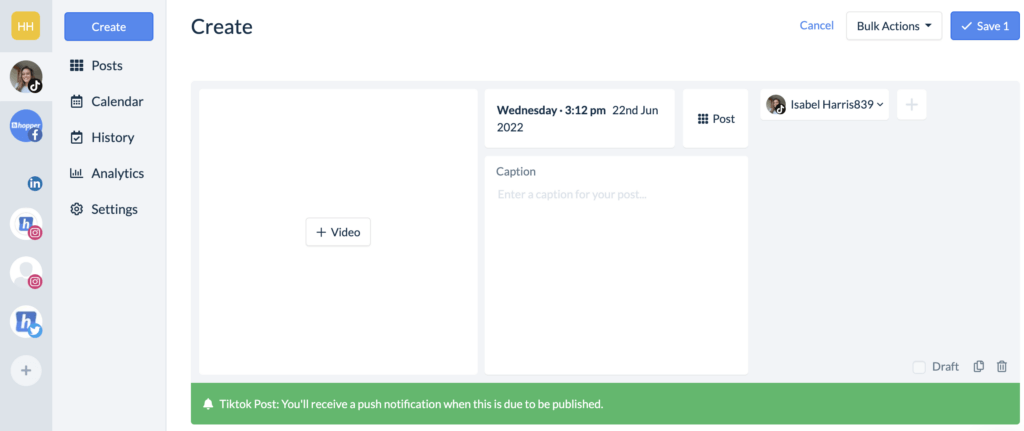
See the full walkthrough in how to schedule TikTok posts from desktop and mobile, and check out the roundup of top TikTok automation tools if you're comparing options.
Schedule with TikTok's native scheduler
TikTok's built-in scheduler is free but limited. It only works from your desktop browser, only from a Business or Creator account, and you can only schedule 15 minutes to 10 days in advance. To use it:
- Log in to tiktok.com in a browser (not the mobile app).
- Click the cloud upload icon in the top right.
- Upload your video and add caption, cover, hashtags, and privacy settings.
- Toggle Schedule video and pick a date and time.
- Click Schedule.
You can't edit a scheduled video after saving. If something needs changing you'll have to cancel and re-upload.
How to go live on TikTok
TikTok Live lets you broadcast in real time, chat with viewers, and receive virtual gifts that convert to real money. You need two things to unlock it:
- You must be 18 or older.
- You must have at least 1,000 followers.
Once you qualify, going live is straightforward:
- Tap the plus (+) icon.
- Swipe across the bottom menu to Live.
- Add a title, a cover, and optional filters or effects.
- Tap Go Live.
- When you're done, tap the power icon to end the stream.
Lives disappear when you end them by default, but you can save the replay from Settings and privacy > Live > Live replay.
TikTok for business
TikTok isn't just for dancing teenagers. Small businesses, e-commerce brands, coaches, agencies, and B2B SaaS companies all get real traction here in 2026. The three big reasons: reach without a big follower base, low production cost (a phone is enough), and buying intent that's climbing fast now that TikTok Shop is fully live in most major markets.
Creator account vs Business account
TikTok has three account types. Choose based on what you're doing:
- Personal: the default. No analytics, no ad tools. Fine for casual users.
- Creator: for individuals building an audience. You get analytics, access to the Creator Fund and Rewards program, TikTok Live, and the full music library.
- Business: for brands and businesses. Analytics, TikTok Ads Manager, the commercial music library (licensed for commercial use), TikTok Shop, appointment booking, and lead-gen forms. You can't use copyrighted popular music on a Business account, so if your growth strategy depends on trending sounds you may prefer a Creator account for the main channel.
What to post as a business
Educational content, behind-the-scenes clips, product demos, customer stories, and answers to common questions all do well. Avoid overly polished ads. The best-performing business TikToks look and sound like a friend giving you a tip.
How to make money on TikTok
There are five main ways to earn on TikTok in 2026:
- TikTok Creator Rewards Program. Replaced the old Creator Fund. Pays creators based on qualified views on videos over one minute long. You need 10,000 followers, 100,000 video views in the last 30 days, and to be 18 or older in an eligible country.
- Brand partnerships. Sponsored videos are still the biggest income stream for most mid-sized creators. Even accounts under 50,000 followers can get paid deals if their audience is well-targeted. See our TikTok Rich List for the top of the market.
- TikTok Shop. Sell physical products directly through your videos and lives, or earn commission by promoting other brands' products as an affiliate.
- Live gifts and subscriptions. Viewers send virtual gifts (which convert to Diamonds, then cash) during your lives. TikTok Live subscriptions let followers pay a monthly fee for perks.
- Driving traffic to your own products. The most reliable long-term play for small businesses. Use TikTok to build an audience, then move them to your website, email list, or app.
TikTok analytics: the metrics that matter
Once you have a Business or Creator account, open Profile > three-line menu > Creator tools > Analytics. You'll see three tabs.
- Overview: video views, profile views, likes, comments, shares, follower growth over 7, 28, or 60 days.
- Content: per-video breakdown including total views, average watch time, watched full video, traffic source, and audience territories.
- Followers: audience size, gender, top territories, and, most importantly, when your followers are most active.
The three numbers to watch every week: average watch time, completion rate, and shares. Watch time and completion tell TikTok your video was worth pushing to more people. Shares are the strongest signal that a video is genuinely resonating.
Common TikTok mistakes to avoid
A few patterns that stall accounts before they get going:
- Posting infrequently. Three videos in a week then nothing for a month. The algorithm needs data to categorize you.
- Trying to be everywhere at once. Broad accounts get less reach than niche ones.
- Ignoring the hook. If viewers swipe in the first 3 seconds, nothing else in the video matters.
- Reposting other people's TikToks with a watermark. The algorithm suppresses this. If you want to reshare, film your own version or use a stitch. If you're pulling TikToks off the platform to reuse, our guide on how to remove the TikTok watermark covers your options.
- Chasing viral instead of building a niche. Viral videos without a clear niche bring you the wrong followers. Better to grow slower with the right people.
- Never checking analytics. You can't improve what you don't measure.
FAQs
Is TikTok free to use?
Yes. TikTok is free to download and free to use. Business and Creator accounts are also free. You only pay if you run TikTok Ads or send Live gifts.
Do I need followers to get views on TikTok?
No. TikTok's algorithm shows your video to a small test audience based on the content itself, not your follower count. If people watch, like, and share, it gets pushed to more people. That's why brand new accounts can go viral.
How long should my TikTok videos be?
Most videos that break through are 15 to 45 seconds. TikTok's Creator Rewards Program pays out on videos longer than one minute, so if monetization matters, aim for 60 to 90 seconds when the content supports it.
How often should I post on TikTok?
Once a day is a strong baseline. Three to five times a week is the minimum if you want the algorithm to learn who your content is for. Consistency matters more than volume.
Can I use TikTok on desktop?
Yes. Go to tiktok.com in any browser. You can browse, upload videos, schedule posts (Business and Creator accounts only), and manage messages. Recording still needs the mobile app.
Can I schedule TikTok videos in advance?
Yes. TikTok's native scheduler works from desktop for Business and Creator accounts, up to 10 days in advance. For unlimited scheduling, cross-posting, and analytics across all your social channels, Hopper HQ handles it end to end.
How much can I earn on TikTok?
It varies hugely. Creator Rewards typically pays between $0.02 and $0.04 per 1,000 qualified views, so a video with a million views might earn $20 to $40 directly. Sponsored posts, TikTok Shop commission, live gifts, and traffic to your own products can each be worth much more.
Do I need special equipment to make TikTok videos?
No. A modern phone is enough. If you want to level up, a $20 ring light and a $30 clip-on microphone will do more for your videos than any camera upgrade.
Should I use a Business or Creator account?
Creator if trending sounds are important to your growth strategy (Business accounts can't use most licensed music). Business if you're running ads, selling on TikTok Shop, or need lead-gen and appointment features. You can switch back and forth from your settings.
Is TikTok safe for my business?
For most businesses, yes. Use a Business account with two-factor authentication, keep customer data on your own website (not in TikTok DMs), and avoid sharing anything you wouldn't want screenshot and reshared. Regulatory changes in a few countries have affected TikTok's availability. If your audience is in an affected market, keep a backup channel like Instagram Reels or YouTube Shorts running in parallel.
What's the difference between TikTok and Instagram Reels?
They look similar, but the culture is different. TikTok rewards raw, unpolished, native content. Reels rewards more produced, aesthetic content. Cross-posting works, but you'll get better results tailoring each video slightly to the platform. Hopper HQ can schedule both from the same calendar.
Now you know how to use TikTok. The only thing left is to start posting. If you'd rather batch a week of content in one sitting and let the scheduling happen automatically, start your free 14-day Hopper HQ trial and plan your first month.
Take your social game further with Hopper HQ.
Plan, schedule and auto-post to every channel in one place. Free for 14 days · Cancel anytime.